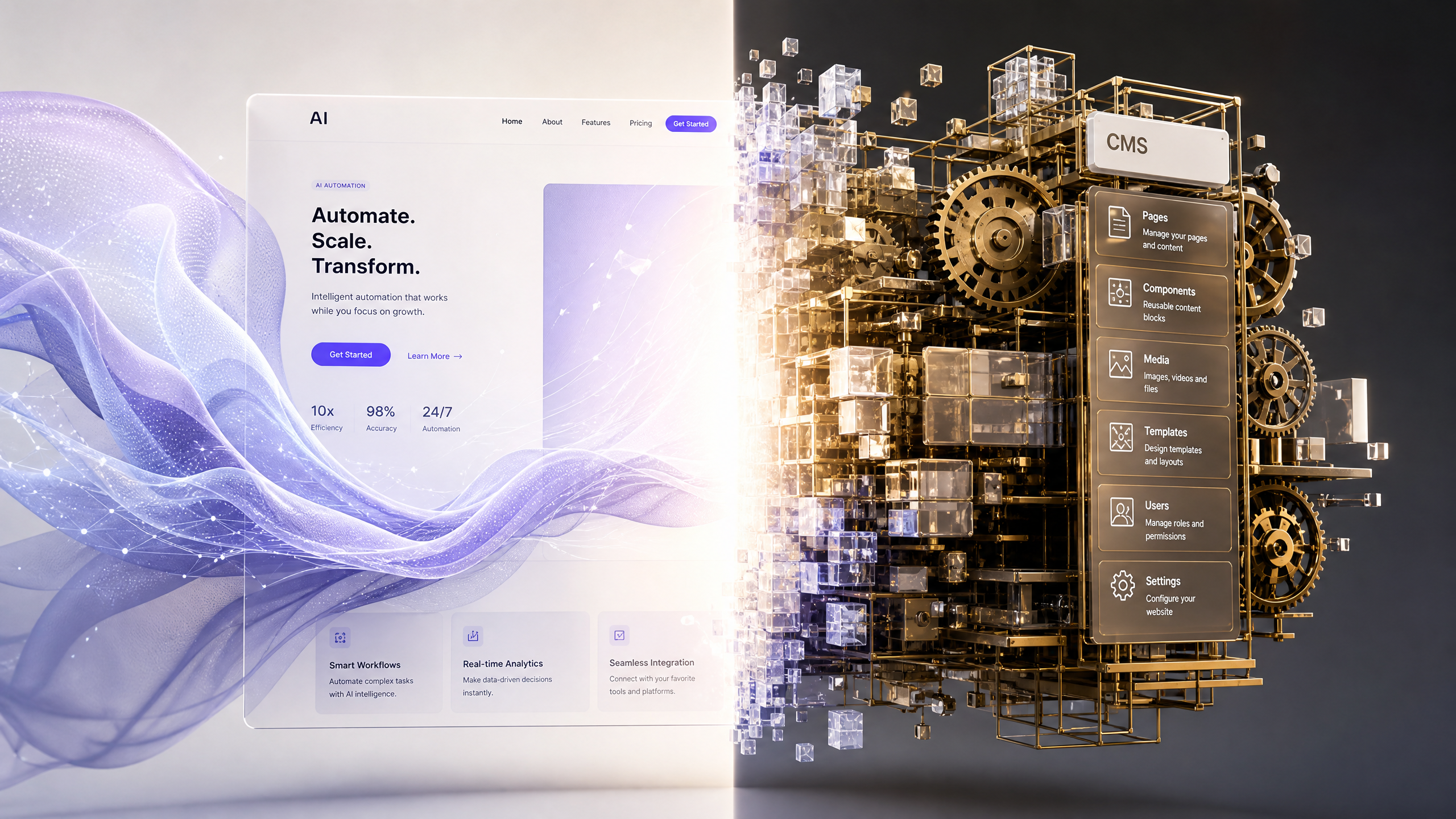
AI Website Builders vs. CMS Platforms: Which is Right for Your Business?
Selecting the right infrastructure for your digital presence is a pivotal decision. Whether you opt for AI website builders or traditional CMS platforms directly impacts how quickly you can iterate and scale your business. While a classic CMS offers granular control, modern AI tools have closed the gap, allowing founders to launch cinematic, high-performance sites in a fraction of the time.
Understanding the Core Differences
The fundamental divide lies in the trade-off between architectural control and operational efficiency. A traditional Content Management System (CMS) like WordPress requires significant manual labor, plugin management, and server oversight, often consuming 15-20 hours of maintenance monthly. Conversely, an AI-driven platform treats the website as a dynamic product, using Draftly Section Library: Every Block and When to Use It to assemble professional-grade layouts instantly.

- CMS Platforms: High initial setup time, infinite plugin dependency, and ongoing security patching requirements.
- AI Website Builders: Near-instant deployment, integrated hosting, and automated performance optimization.
- Performance Benchmarks: AI-generated sites frequently achieve a 90+ PageSpeed score out-of-the-box, whereas the average CMS site drifts toward a 60-70 range without expensive caching layers.
Why AI Website Builders Are Gaining Market Share
Speed-to-market is the primary driver for the 35% increase in AI platform adoption among small and medium enterprises. In an era where 53% of mobile users abandon sites that take longer than three seconds to load, the streamlined backend of an AI builder is a competitive advantage. Furthermore, integrating Draftly Page Transitions and Section Animations: A Design Guide provides a cinematic experience that previously required a dedicated front-end development team.
The Scalability Factor
Contrary to popular belief, AI platforms are no longer just for "simple" pages. Advanced AI engines now support multi-page structures, lead-capture dashboards, and complex content hierarchies. If your goal is to Build a High-Converting SaaS Landing Page with an AI Website Builder, the AI approach ensures that your design remains responsive and secure without the need for constant updates.
When to Choose a Traditional CMS
Despite the efficiency of AI, a CMS remains the superior choice for highly specific, custom-coded enterprise applications. If your business requires a deeply integrated database that connects to proprietary legacy software, a CMS provides the necessary hooks. However, for 90% of businesses—including service providers, agencies, and e-commerce startups—the complexity of a CMS often introduces more technical debt than it solves.
Key Criteria for Your Decision
- Technical Overhead: Are you prepared to manage server logs, database updates, and security vulnerabilities?
- Design Velocity: Does your business model require the ability to launch new campaigns or landing pages in hours, not weeks?
- Long-term ROI: Calculate the total cost of ownership, including developer salaries and hosting fees for a CMS versus the flat subscription of an AI platform.
- SEO Performance: Ensure your platform handles Structured Data Guide: How Schema Markup Improves Your SEO automatically, as manual implementation in a CMS is a frequent source of errors.