3D Websites for Indian Restaurants & Cloud Kitchens: Show, Don't Tell
Food is the most visceral of all purchase decisions. No industry is more dependent on the power of sensory experience — the smell of freshly made biryani, the visual appeal of a perfectly plated dosa, the ambient warmth of a well-lit dining room — to drive customer decisions. And no industry has been slower to realise that these sensory experiences can and must be translated into the digital world.
India's food service industry is valued at approximately ₹5.99 lakh crore ($72 billion), making it the third-largest service sector in the country. But the majority of Indian restaurants, cloud kitchens, and F&B brands still treat their websites as an afterthought — a page that lists the address and maybe links to a Zomato profile. In 2025, this approach is not just a missed opportunity. It is a slow surrender of brand equity and margin to third-party aggregators.
The Aggregator Trap and How to Escape It
Zomato and Swiggy have been transformative for Indian food delivery. But their model comes with a cost that is becoming unsustainable for many operators: platform commissions of 18–30% per order, combined with increasing competitive advertising spend within the platforms, are compressing restaurant margins to near zero — or below.
Operators who have tried to reduce their aggregator dependence by building direct order channels share a common insight: direct orders are almost always more profitable, but only if you give customers a compelling reason to order direct.
That reason, increasingly, is the experience that a premium restaurant website provides. When a customer orders directly through a restaurant's own website:
- The restaurant keeps the full margin
- They own the customer relationship and data
- They can build a loyalty programme
- They can communicate directly for future offers
The challenge is that most restaurant websites in India are not compelling enough to motivate a customer to choose them over the convenience of a Swiggy interface they already know. A 3D, immersive restaurant website changes this calculus.
What an Immersive Restaurant Website Looks Like
The most effective restaurant and F&B brand websites in 2025 leverage immersive, 3D-capable design to achieve specific commercial goals:
Virtual Dining Room Tours
For sit-down restaurants, a virtual walkthrough of the dining space is one of the most powerful booking conversion tools available. A family choosing a venue for a birthday dinner, or a couple selecting a restaurant for an anniversary, makes a significant portion of their decision based on ambience. A 3D walkthrough — allowing users to explore the lighting, seating arrangement, decor details, and views — provides the ambience communication that a static photo gallery fundamentally cannot.
Karavalli, ITC Hotels' acclaimed South Indian fine dining restaurant in Bengaluru, has used immersive digital experiences to maintain premium positioning and direct reservation volume despite aggregator competition. The principle applies equally to premium casual dining operators across India.
Interactive Menu Presentation
3D food presentation is transforming how menus are experienced online. Instead of a PDF menu or a flat list with thumbnail images, imagine being able to rotate a biryani portion to see its composition, zoom into the garnish on a dal makhani, or see the cross-section of a pastry. For premium restaurants, this level of presentation justifies premium pricing and reduces order regret — customers know exactly what they are getting.
This approach works particularly well for:
- Tasting menu restaurants where the composition and presentation of dishes is central to the value proposition
- Dessert and cafe concepts where visual appeal is the primary purchase driver
- Regional cuisine specialists who need to communicate the authenticity and craft behind dishes that may be unfamiliar to their audience
Cloud Kitchen Brand Building
Cloud kitchens face a unique challenge: they have no physical presence to anchor their brand. When Rebel Foods (the company behind Faasos, Behrouz Biryani, and The Good Bowl) builds a brand, the entire brand experience happens through the digital interface and the food itself. There is no restaurant ambiance to leverage.
For cloud kitchen operators, a premium website is not supplementary marketing — it is the primary brand asset. A beautifully designed, immersive website for a cloud kitchen brand communicates:
- The craft and thought behind the food
- The brand's positioning (premium vs. everyday, indulgent vs. healthy, regional vs. fusion)
- The team's passion and expertise
- Why ordering direct (rather than through Zomato) is the right choice
Rebel Foods' individual brand websites — particularly Behrouz Biryani, which leans heavily on storytelling and immersive visual design — demonstrate what is possible when cloud kitchen brands treat their websites seriously.
The SEO Dimension: Winning Local Food Search
One of the most underutilised growth channels for Indian restaurants is local search engine optimisation. When a person in Koramangala Bengaluru searches "best biryani near me" or "rooftop restaurants Indiranagar," Google surfaces a mix of aggregator listings and direct business websites. The restaurants with well-optimised websites — fast loading, mobile-first, with proper local SEO signals — frequently appear alongside aggregator listings in these searches.
The critical difference: a user who clicks through to a restaurant's own website is more likely to make a direct reservation or order than one who discovers the restaurant through Swiggy and orders through the platform by default.
For Indian restaurants building their first professional website, the beginner's guide to building your first 3D website provides a practical starting point. Understanding the broader landscape of how 3D websites outperform static sites in engagement is covered in Top 10 Use Cases for 3D Websites in 2026.
The Dhaba and Regional Format Opportunity
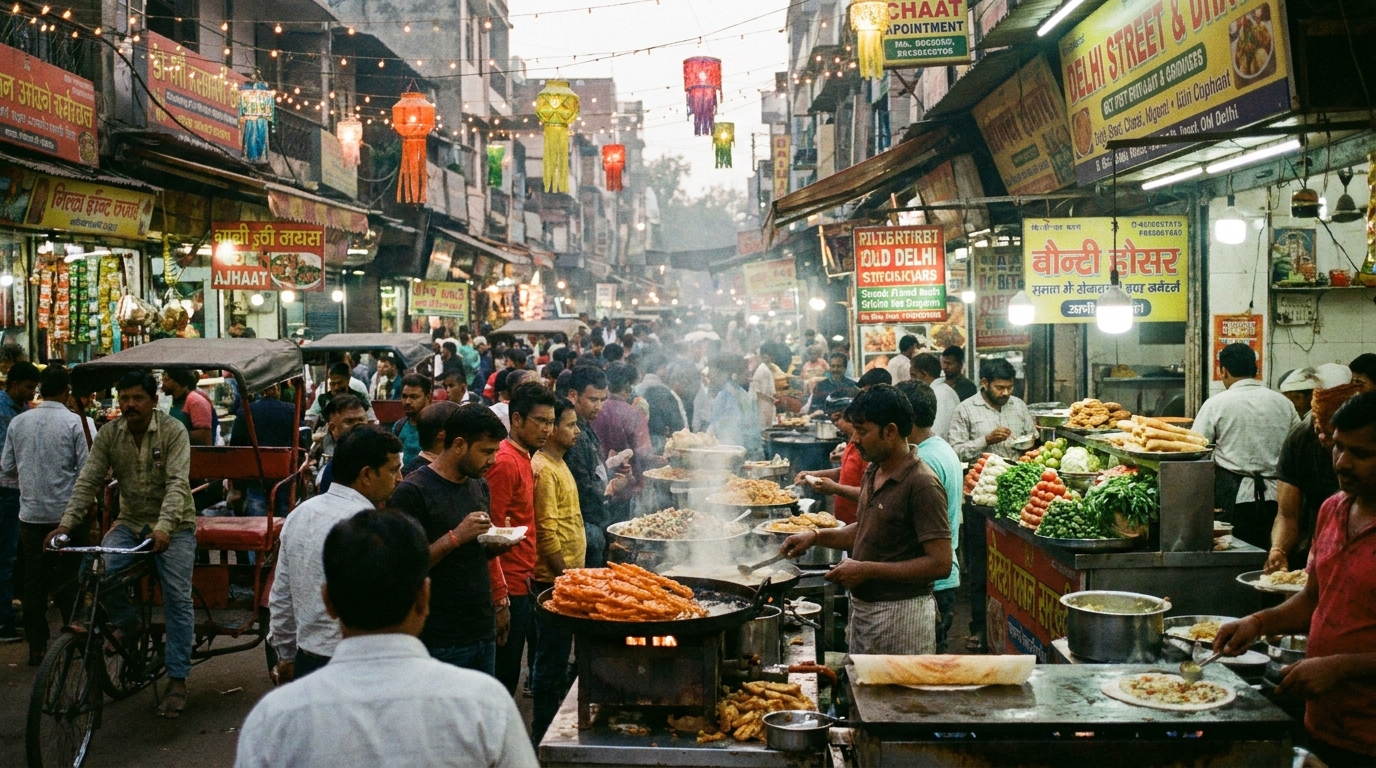
An often-overlooked segment is India's iconic dhaba culture — roadside and highway eateries that serve millions of Indians daily and represent a significant portion of the unorganised food service market. A growing number of premium dhaba-style brands — Highway King, Dilli 6, and various regional operators — are building organised chains and need digital identities to match their physical ambitions.
For these brands, an immersive website serves a dual purpose:
- Operational: driving catering enquiries, corporate lunch orders, and event bookings that are higher-margin than walk-in covers
- Brand building: communicating the authentic heritage and quality credentials that justify the premium positioning these brands are attempting
The digital presentation of authenticity — the worn wood textures, the tandoor smoke, the family recipes — is exactly where immersive web design earns its keep for dhaba-format operators.
Practical Implementation: What Indian F&B Operators Need
Building an immersive restaurant website does not require a Fortune 500 budget. The essential components for an Indian restaurant or cloud kitchen website in 2025 are:
High-quality food photography and videography. No web design technology compensates for poor food photography. A ₹15,000–₹25,000 investment in professional food photography is the foundation of everything else.
A mobile-optimised, fast-loading framework. Restaurant web traffic is overwhelmingly mobile. A site that loads in under 2 seconds on a 4G connection is non-negotiable.
Online ordering integration. Direct orders through the website should be seamless — integrated with the restaurant's kitchen management system, offering real-time availability, and competing on convenience with aggregator interfaces.
Table reservation functionality. For sit-down restaurants, an online reservation system with real-time availability removes friction from the booking process.
Rich media experience. Ambient video of the dining room, 3D dish presentations, virtual kitchen tours — these elements differentiate the website experience from anything an aggregator can offer.
Platforms like Draftly provide restaurant and F&B templates with these capabilities built in, enabling operators to launch premium digital experiences without a custom development engagement.
The Compound Advantage of Direct Digital Relationships
Every customer who orders directly through a restaurant's website — rather than through Zomato or Swiggy — is a customer whose data the restaurant owns. Their contact details, order history, preferences, and visit frequency can drive:
- Personalised remarketing (birthday offers, loyalty programme notifications)
- Off-peak demand stimulation (Tuesday lunch specials targeted at previous customers)
- Catering and events pipeline (corporate lunch enquiries, birthday party bookings)
India's food industry is too rich, too diverse, and too craft-oriented to be permanently mediated by two platforms taking 25% of every transaction. The restaurants and cloud kitchens that build premium direct channels now will own the economics of the next decade. Show your food, your space, and your story in the most compelling way possible — and give customers a reason to come directly to you.