Draftly vs Squarespace: AI-First vs Template-First in 2026
Choosing between Draftly vs Squarespace usually comes down to one philosophical question: do you want a website that's generated for your business in minutes, or do you want to start from a polished template and customise your way to launch? Both work. But they suit very different builders, budgets, and outcomes — and the gap between them has widened sharply in 2026 as AI generation has matured.
This comparison cuts through the marketing language. We'll look at what each platform actually does, where each one wins, where each one struggles, and which builder is the right fit for which use case. By the end, you'll have a clear recommendation based on your specific situation — not a generic "both are great" cop-out.
The Core Philosophy: Generation vs Selection
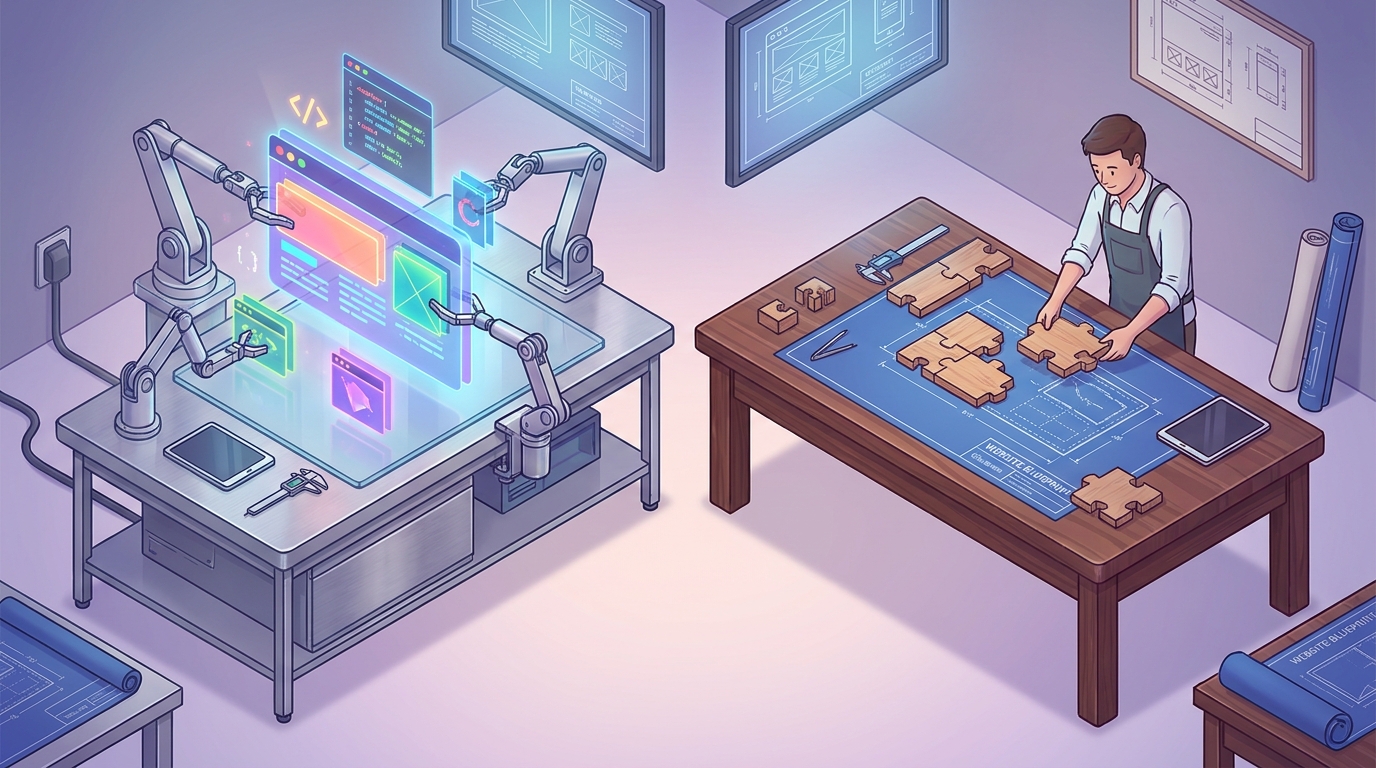
Squarespace, founded in 2003, is the polished elder of the template-first world. You pick from roughly 150+ curated templates, swap in your content, tweak the design system, and publish. It's the design equivalent of buying a tailored suit off the rack — beautiful baseline, limited cuts.
!draftly vs squarespace aifirst vs templatefirst in 2026, product
Draftly takes the opposite approach. You describe your business in a sentence or two, and an AI engine generates a complete, cinematic, scroll-driven 3D website tailored to your industry — copy, layout, motion, and imagery included. There's no template gallery to scroll through because no two generated sites are quite the same.
The practical implication:
- Squarespace rewards designers who enjoy the craft of customising
- Draftly rewards operators who want a unique site shipped today and refined tomorrow
Design Output: Where the Visual Gap Shows
Squarespace templates are clean, magazine-style, and conservative by design — they have to look good for everyone from photographers to law firms. That universality is also their ceiling. Walk through 50 Squarespace sites in a row and they start to blur.
Draftly's output is cinematic by default: scroll-driven 3D scenes, video hero sections, motion-rich transitions. For a deeper look at how this works, see our guide on 3D animation on websites: when to use it and when to avoid it. The trade-off is that Draftly sites lean dramatic — great for brands that want differentiation, less ideal for someone who wants a strictly minimalist blog.
Customisation Depth
- Squarespace: Style editor with fonts, colors, sections, and a block-based builder. Direct CSS injection available on Business plan and above.
- Draftly: AI chat editing — describe the change in plain English ("make the hero darker, add a testimonials section, replace the third image") and it applies. Plus manual fine-tuning of sections, fonts, brand kit, and motion.
Speed to Launch: The Real Numbers
Let's get specific. Building a 6-page service business site:
| Stage | Squarespace | Draftly |
|---|---|---|
| Initial design | 4–8 hrs picking & adapting template | 2–4 min AI generation |
| Copywriting | 6–10 hrs writing from scratch | Generated, then edited (1–2 hrs) |
| Imagery | 2–4 hrs sourcing stock | AI-generated + uploads |
| Refinement | 4–6 hrs | 1–2 hrs via chat editing |
| Total | 16–28 hours | 2–4 hours |
For agencies and freelancers, this compounds. We've covered how agencies are scaling to 50+ client websites with Draftly — a workflow that's effectively impossible on Squarespace without huge headcount.
SEO and Performance Comparison
This is where the conversation gets honest. Squarespace has a 20-year head start on SEO tooling, and it shows in some areas — but performance has been a persistent weakness.
On-page SEO
- Squarespace: Built-in meta tag editor, automatic sitemap, AMP for blogs (deprecated 2024), structured data on certain templates.
- Draftly: Full SEO panel per page, automatic schema markup, image alt-text generation, sitemap and robots.txt control. Covered in detail in the Draftly SEO Panel guide.
Core Web Vitals
Squarespace's average LCP across published sites sits around 3.2 seconds (per HTTPArchive 2025 data) — above Google's 2.5s threshold. Draftly publishes static, edge-cached output averaging 1.4–1.9s LCP despite heavier visuals, thanks to lazy-loaded 3D scenes and aggressive media optimisation. If site speed matters to your rankings (and it does — see how Google actually ranks websites in 2026), this gap is significant.
Pricing: What You Actually Pay
Squarespace pricing in 2026:
- Personal: $16/month — basic site, no e-commerce
- Business: $23/month — promotional pop-ups, advanced metrics
- Commerce Basic: $28/month — sell products, no transaction fees
- Commerce Advanced: $52/month — abandoned cart, subscriptions
The hidden cost on Squarespace is time. At a freelancer rate of ₹2,000/hour, the 20-hour build delta between platforms is ₹40,000 in labor per site. For agencies, that's the difference between profitable and break-even.
Where Squarespace Still Wins
Let's be balanced. Squarespace remains the stronger choice when:
- You're building a serious blog or editorial site. The blogging CMS, comment system, and category structure are more mature.
- You sell physical products at scale. Squarespace Commerce, while not Shopify-grade, handles inventory, shipping zones, and tax automation well.
- You want a strictly minimalist, print-inspired aesthetic. Squarespace's templates are still some of the cleanest on the market.
- You're already invested in the Squarespace ecosystem (Acuity Scheduling, Unfold, etc.).
Where Draftly Wins Decisively
Draftly is the clearly better choice when:
- You want a visually distinctive site fast. Cinematic 3D scrolls are not something Squarespace ships. See why 3D websites are the next frontier for brand differentiation.
- You're a freelancer or agency. Build-time economics favor AI generation by an order of magnitude.
- You want to iterate via natural language. Chat-based editing is a workflow shift, not a feature.
- You're in a market where standing out matters more than blending in — D2C brands, SaaS, premium services, creators, luxury goods.
- You're not a designer and don't want to become one.
A Quick Decision Framework
Ask yourself three questions:
- Do I value uniqueness over convention? → Draftly
- Do I have 20+ hours to dedicate to building? → Squarespace is workable
- Will I update the site frequently? → Draftly's chat editing wins long-term
The Verdict: Which One Should You Pick?
For most service businesses, startups, agencies, freelancers, and modern D2C brands launching in 2026 — Draftly is the stronger pick. The combination of generation speed, design distinctiveness, and chat-based iteration solves problems Squarespace doesn't even try to solve.
For traditional blogs, content-heavy editorial sites, and merchants with deep Squarespace ecosystem dependencies — Squarespace remains a defensible choice.
The template-first era of website building dominated 2010–2022. The AI-first era is now the default for new builders who value time, differentiation, and conversion. If you're starting today, the question isn't really which is better in absolute terms — it's which philosophy matches how you want to work.
Try generating a site with one prompt before you commit to weeks of template customisation. The 10 minutes it takes to test will tell you more than any comparison post — including this one. Start your free Draftly site and see what your business looks like in cinematic 3D.