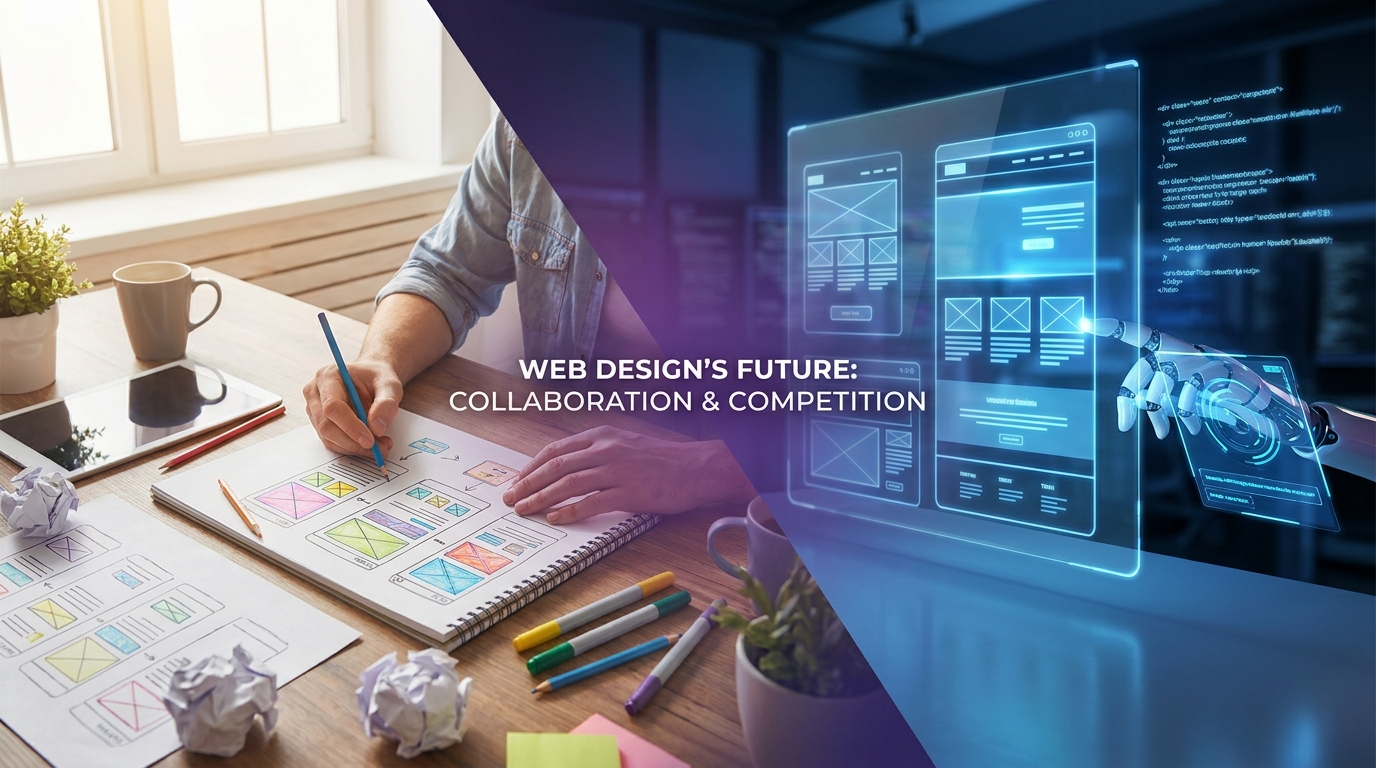
The debate over AI vs. Human Web Designers isn't just a hypothetical anymore; it’s a practical business decision companies are making every day. The promise of generating a website in 60 seconds challenges decades of established design processes. But does speed and automation trump the nuance, strategy, and creative spark of a human professional? The answer for 2025 isn't about a clear winner, but a fundamental shift in how websites are created.
This isn't a story of replacement. It's a story of redefinition. We’re moving past the simple binary of AI versus human and into an era of collaboration. By breaking down the distinct advantages of each, we can see a clearer picture of the future—one where AI handles the scale and humans command the strategy.
The AI Advantage: Speed, Scale, and Data-Driven Design
Artificial intelligence excels at tasks that are repetitive, data-intensive, and require rapid iteration. In web design, this translates into a production powerhouse, tackling the foundational work that once consumed hundreds of hours.
!ai vs human web designers who wins the battle for 2025, industry
Unmatched Speed and Efficiency
An AI website builder can produce a complete, multi-page first draft in less than a minute. A human designer or a small agency, by contrast, typically spends 40 to 150 hours on discovery, wireframing, mockups, and initial development for a standard business website. This 99.9% reduction in initial creation time is the single most disruptive factor AI brings to the table.* For Startups: A new venture can test five different landing page concepts in an afternoon, a process that would have taken weeks and thousands of dollars.
* For Agencies: The initial site structure and layout can be generated instantly, allowing designers to jump straight into customization and high-value strategic input.
Data-Informed Layouts
AI doesn't guess what a good layout is. It analyzes the architecture of millions of high-performing websites. It understands where users expect to find a call-to-action, how much text is optimal for a hero section, and which visual flows lead to the highest engagement. This data-backed approach means an AI-generated site is often born with a 15-20% higher baseline conversion potential than a site designed purely on aesthetic intuition.Radical Cost-Effectiveness
The financial argument is compelling. The median cost for a professionally designed small business website in 2024 hovers between $5,000 and $20,000. An AI website builder subscription offers a comparable, if not more advanced, initial product for a tiny fraction of that cost. The AI Website Builder vs. Web Agency in 2026: The Real Cost Comparison reveals that businesses can save up to 98% on upfront development costs, reallocating that capital to marketing and growth.The Human Touch: Strategy, Empathy, and Brand Storytelling
While AI crushes the competition on speed and data processing, it struggles with the abstract, emotional, and strategic elements that turn a functional website into a memorable brand experience.
Deep Brand Understanding and Nuance
A human designer can sit in a discovery meeting and understand not just what a company does, but why it does it. They can interpret the subtle cues of a founder's passion, the specific anxieties of a target customer, and the long-term vision of the brand. An AI operates on the explicit instructions in a prompt; a human operates on intuition and empathy. This is crucial for brands where feeling and story are paramount, like a luxury watchmaker or a non-profit organization.Strategic User Experience (UX) Design
AI is brilliant at User Interface (UI) design—arranging the components. Humans, however, own User Experience (UX) strategy—understanding the user’s entire journey. A human UX designer conducts interviews, builds user personas, maps out complex decision trees, and designs for emotional outcomes. They ask questions AI can't:* What is the user feeling when they land on this page?
* What information do they need to feel confident enough to book a demo?
* How does this page fit into their broader interaction with our brand across social media, email, and sales calls?
True Creativity and Breakthrough Ideas
Generative AI is, by its nature, a remixer. It creates new combinations based on its vast training data. It cannot, however, create a truly novel concept that breaks established patterns. The most iconic and effective web designs often defy convention. A human designer can invent a new interaction model or visual metaphor that sets a brand apart. This is especially true as we see Why 3D Websites Are the Next Frontier for Brand Differentiation; these immersive experiences require a level of artistry and narrative thinking that is currently a uniquely human skill.AI vs. Human Web Designers: A Head-to-Head Comparison
To make the choice clearer, here’s a direct comparison of their core competencies. This isn't about good vs. bad, but about identifying the right tool for the right job.
| Feature | AI Designer (like Draftly) | Human Designer |
|---|---|---|
| Initial Speed | Seconds to minutes | Weeks to months |
| Upfront Cost | Low (Subscription) | High (Project Fee/Salary) |
| Originality | High-quality remix of proven patterns | Potential for true novelty |
| Brand Strategy | Interprets prompts literally | Deeply understands nuance & vision |
| UX Design | Data-driven UI | Strategic, empathy-driven UX |
| Data Analysis | Analyzes millions of sites for patterns | Analyzes project-specific user data |
| Maintenance | Simple, no-code updates | Requires retainers or new contracts |
| Iteration | Instant and virtually unlimited | Time-consuming and costly |
The Winner in 2025 Isn't a "Who" — It's a "How"
The most forward-thinking businesses and agencies are realizing the debate is flawed. The ultimate victory doesn't belong to AI or to humans, but to those who master the collaboration between them. The winning model for 2025 is the AI-augmented workflow.
The AI-Augmented Human Designer
For creative professionals and agencies, AI is becoming the most powerful assistant they’ve ever had. Instead of spending 80% of their time on tedious, low-level tasks like building basic page structures, sourcing stock images, or writing placeholder copy, they can offload that to AI. This flips the script:- Generate the Foundation: Use an AI tool like Draftly to create a complete, high-quality 3D website in minutes based on a client brief.
- Elevate with Strategy: Spend 80% of their time on what truly matters: refining the user journey, developing a unique brand narrative, and creating custom visual assets that make the site unforgettable.
- Ship and Iterate Faster: Deliver a superior product in a fraction of the time, dramatically increasing profitability and client satisfaction.
The Human-Supervised AI
For entrepreneurs and small businesses, the dynamic is similar. They can use an AI website builder to get 90% of the way to a world-class website instantly. The final 10% is where their unique human insight comes in. After the AI generates the site, the business owner can step in to make those crucial final touches that only they would know. They can How to Customise Your AI-Generated 3D Website — Full Guide, tweaking the copy to perfectly match their brand voice or swapping an image to one that features their actual team.So, who wins in 2025? The winner is the marketing agency that uses AI to triple its client capacity. The winner is the startup that uses AI to launch its MVP in a weekend, not a quarter. The winner is the human designer who is freed from monotony to focus on the strategic, creative work they love.
The future is not about choosing between AI and human designers. It's about choosing the intelligent framework that leverages the best of both. The tools are here, and the new era of web creation has already begun.
Ready to see what an AI-first design process feels like? Generate your cinematic 3D website with Draftly in 60 seconds.


